

By Meg Reynolds,
Published On 06/30/2025
The Unfixable Feeling
“There’s a particular shame in admitting vulnerability when you don’t have a way to fix it—or at least make it poetic.” —The New York Times
That line landed in me like a truth I didn’t want to say aloud.
It’s one thing to feel pain and then dress it up in insight, turn it into a story with an arc and redemption.
But what about the jagged, unattractive feelings that bubble up raw and unfiltered? The petty ones. The ones that feel unworthy of a wise person.
That’s where I found myself today.
Someone came into my awareness—a woman I know—and I noticed my mind begin to wander. Subtle judgments and comparisons started to arise; not out loud, just quiet thoughts moving through me.
At first, they felt casual and fleeting, but I soon realized they were leaving a weight on me. The tone had shifted, and what seemed like harmless mental chatter began to feel burdensome.
I started to feel small.
The Shame Spiral
Then came the turn.
My thoughts shifted to the people I love most. Would they uphold the unspoken distance I felt towards this woman? Or would they, in their usual ebullient and kind way, greet her with warmth and grace?
Would that be a betrayal of me?
And there it was: the shame spiral.
What kind of woman—what kind of teacher, mother, human—casts judgment on another woman and mother? Especially one I know has suffered. One who, like me, has struggled in relationships, in parenting, in her professional life.
Why wouldn’t I feel only compassion?
Why wouldn’t I recognize our shared humanity?
Fortunate
Here’s the thing: I am fortunate. I’ve spent the last 30 years of my life learning to examine my motives. To call myself out when I’m hiding something rotten behind something shiny.
I’ve repaired relationships.
I’ve softened.
I’ve learned not to feel entitled to spray my mood all over the people around me.
This is what I learned through Alcoholics Anonymous. The shift from a purely individual experience to one that is deeply and universally human.
And when I layered in Vedic Meditation—encouraged to learn it in my mid-20s—I found a new kind of softness, a new way to surrender the suffering.
That combination rerouted me from a path of self-destruction to a life that includes purpose, joy, pain, and the ability to release the suffering those things can bring.
What I Love Most
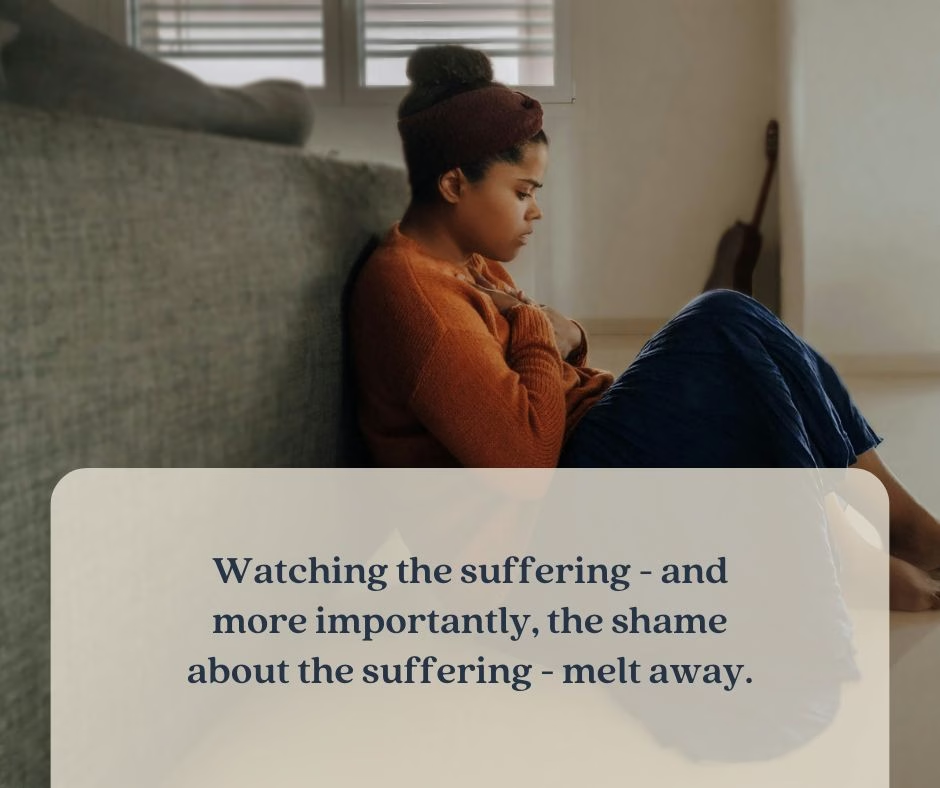
This is what I love most about teaching Vedic Meditation: Watching the suffering—and more importantly, the shame about the suffering—melt away. I love seeing students soften in the way I had. Watching their dignity return. Their faces light up with a childlike expression. A delight that says: I’m allowed to feel better.
A Soft Landing
We all spiral sometimes. We all catch ourselves thinking things we know we’ve outgrown.
But the work is not about never feeling those things—it’s about noticing them, understanding them, and gently rerouting ourselves.
That is what practice looks like. Not perfection, but presence.
If you’re ready to meet yourself in a new way—to soften, to unravel the shame, to find a soft landing—I invite you to join one of my upcoming Vedic Meditation courses.
Reach out to me directly to hear about the many offerings I have coming up. I would love to help you experience the gentle power of this practice.
Let’s sit together in what’s real. Let’s meditate.
P.S. Don't LET YOUR FRIENDS MISS OUT. Share this article:

Start Your Journey
Receive Expert Guidance on Meditation and Igniting Happiness
"*" indicates required fields
By submitting your information, you consent to subscribe to Meg Reynolds email list. See Privacy Policy.