
Article
11th Step Meditation: A Personal Share from the Rooms of AA
Category:

By Meg Reynolds,
Published On 01/26/2026
I didn’t come to meditation looking for enlightenment. I came because my nervous system was on fire and my mind was pummeling me with flashbacks of things I’d said and done that I could hardly remember. Were they true? Were they false? If you’re in Alcoholics Anonymous and trying to figure out how the 11th Step meditation part works, this story might sound familiar.
My first attempt at meditation was a complete disaster. I was sprawled on the hardwood floor of my barely furnished Sacramento apartment, trying to follow a “Global Meditation” CD I panic-bought at Borders bookstore. I was a few days sober. Instead of peace, I got mental chaos—three or four radio stations blasting at once, all fighting over the same terrible song. The harder I tried to quiet my mind, the louder it got.
This led to more drinking.
So I decided meditation wasn’t for me. Case closed.
And honestly, culturally? The whole thing seemed suspect. Growing up in the ’70s, I thought meditation was for naked hippies on acid, chanting at the moon. I was raised in an alcoholic home by pseudo-beatniks who were really just aging wastoids, like myself. The word “hippie” might as well have been a four-letter word. Between my family mythology and my internal circus, meditation stayed firmly in the no thanks category.
But life, as it tends to do, kept pressing in.
At the time, I was touring with a redux band from the ’60s and ’70s—less sex, drugs, and rock ’n’ roll; more booze, near liver transplants, and creative stagnation. In a desperate attempt to simplify, I moved to a cabin in Alaska with no running water to drink myself to death. After nine more months of end-of-the-road drinking, winter was coming—and I was at my breaking point but not dead, yet.
I’ve heard us alcoholics referred to as ironweeds… we can be tough to kill.
I returned to California exhausted, humbled, and finally willing to listen.
A woman in AA named Shannon became my sponsor and showed me how to take the 12 steps. She gave me the knowledge and experience to stay sober, no matter what. Then she boldly told me I needed to learn to meditate—and where to learn. The 11th Step, as you probably know, keeps nudging us to “improve our conscious contact” with something steadier than our spiraling thoughts.
Prayer was easy, I thought—just beg and cry and feel guilty, right?
Wrong.
Meditation was still suspicious. But Shannon hadn’t steered me wrong so far, so I went for it.
On November 10, 1996—my 25th birthday—I learned Vedic Meditation.
I was sure it wouldn’t work.
And then, twenty minutes later, something extraordinary happened.
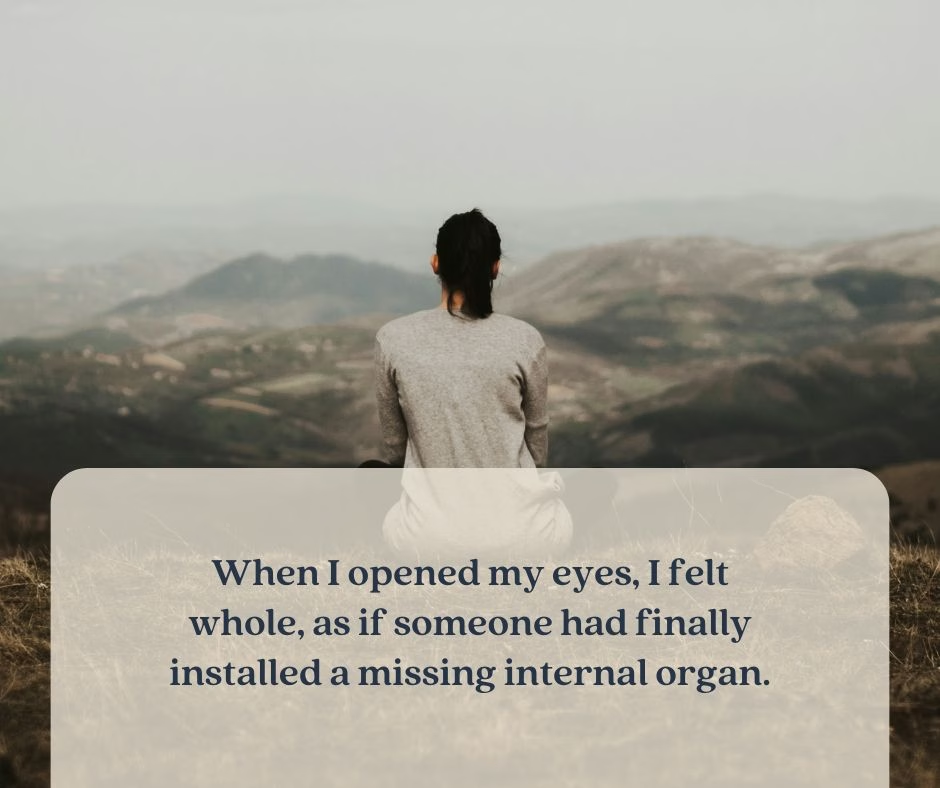
My body settled into deep rest. The noise in my mind didn’t get forced silent—it simply organized itself and then disappeared. All the static came together into one clear, grounded signal. When I opened my eyes, I felt whole, as if someone had finally installed a missing internal organ.
That became my 11th Step meditation practice—steady, effortless, reliable contact with something deeper than the chaos.
Me, minus the scrambling.
Minus the old stories.
Minus the fear running the show.
And here’s the confession part—the kind we share in AA basements and church basements everywhere:
After all my resistance to meditation… I can’t imagine living without it now.
It became so stabilizing, so supportive of my sobriety, and so calming to my nervous system that I went all in. I became a Vedic Meditation teacher, completed more than 2,500 hours of training in India, and earned a Master’s degree in Education from the University of Virginia, focusing on social and emotional learning and mindfulness.
I didn’t do any of that for spiritual bragging rights.
I did it because the practice worked—consistently, reliably, undeniably.
Today—nearly 30 years later—science confirms what I felt on day one: stronger attention, better emotional regulation, lower stress accumulation, and a more responsive (not reactive) brain. If you’d like to explore this further, you may also enjoy Vedic Meditation and Emotional Resilience or Nervous System Regulation: Finding Hope Through Meditation.
But for me, the real gift is simpler:
Meditation didn’t give me a different life. It gave me a different relationship with the life I already have.
It taught me how to be here—present, grounded, connected, and available for what matters. And it has been a vital step in staying away from a drink or a drug… for 30 years.
For this alcoholic, that changed everything.
If you’re in AA and struggling with the 11th Step… you’re not alone.
Many of us can pray, but the meditation part feels impossible.
Or frustrating.
Or boring.
Or like you’re doing it wrong.
Here’s the truth:
You’re not doing anything wrong—you just haven’t learned how to meditate, yet.
There is a gentle, effortless way to meditate that works beautifully for people in recovery.
If you want to learn Vedic Meditation—or simply explore what meditation could look like as part of your 11th Step—I’d love to support you.
P.S. Want support with the meditation side of the 11th Step—without forcing, struggling, or white-knuckling it? Book a free 15-minute intro call here.
You don’t have to white-knuckle meditation.
There’s a way to do this that feels like coming home.
Quick Recap: Your Questions Answered
Sometimes you just want the heart of it—here are the key takeaways and common questions people ask.
The 11th Step encourages improving conscious contact through prayer and meditation. For many in recovery, meditation provides a practical, embodied way to settle the nervous system and connect beyond mental chatter.
Early sobriety often comes with heightened nervous system activation, racing thoughts, and stored stress. Many meditation techniques rely on effort or concentration, which can make things feel worse rather than better.
Vedic Meditation is effortless. It doesn’t require focusing, controlling thoughts, or trying to quiet the mind. The practice allows the nervous system to settle naturally, which can be especially supportive in recovery.
Yes. Regular meditation helps reduce stress accumulation, improve emotional regulation, and support a calmer, more responsive nervous system—all of which can strengthen long-term recovery.
No. Vedic Meditation is a mental technique, not a belief system. It can complement prayer or spirituality, but it doesn’t require adopting any philosophy to be effective.
P.S. Don't LET YOUR FRIENDS MISS OUT. Share this article:

Start Your Journey
Receive Expert Guidance on Meditation and Igniting Happiness
"*" indicates required fields
By submitting your information, you consent to subscribe to Meg Reynolds email list. See Privacy Policy.