

By Meg Reynolds,
Published On 04/09/2026
This morning, I listened to a podcast episode that moved me more than I expected.
It was an episode of The David Magee Show called “Weathering the Unexpected Storm” — a conversation between David Magee and his wife, Kent, about the literal storm blanketing much of the East Coast with snow, ice, and freezing temperatures.
Schools closed. Families stuck inside. Parents trying to keep children warm, fed, occupied, and regulated while the world outside stays frozen.
It was a caring, real-time window into what’s happening in their community.
But what touched me most wasn’t the weather.
It was the way David and Kent spoke to each other.
This was the first time I’ve heard David speak, and I was struck by the tenderness between them — their differing opinions playfully brought to life, surprising even themselves a little. Neither held back. Neither hardened.
It was endearing and refreshing… like watching two people remain honest inside the everyday mess.
On February 18 I spoke at a mental health symposium where David was the keynote speaker, addressing the mental health and substance misuse crisis among young people.
Listening today felt like seeing the humanity behind the work.
And then something happened in the conversation that stopped me.
When Kent Said the Unsayable
At one point, Kent mentioned feeling a frustration with the storm that sounded like it bordered on panic — the kind of overwhelm that can rise when life feels precarious.
And then she said, almost from the depth of her body:
“I wish William hadn’t died.”
William was their eldest son, who died from an accidental drug overdose after graduating from college.
When Kent expressed that longing, that ache, I recognized something instantly.
Something I have known intimately.
I call it…
the deepest pain.
The Deepest Pain Is Not Logical
The deepest pain is not always attached to what’s happening in the moment.
It gets triggered by anything that causes an emotional spike — anything that floods the bloodstream with chemistry.
Acute anxiety about how to handle something.
Overjoy at something wonderful.
The sudden ache of loneliness.
Whatever the current event, it touches that same tender place.
And intellectually, it can feel incongruent.
Embarrassing, even.
Like: Shouldn’t I be over this by now?
And yet…
In the purest sense, I don’t want to bypass it.
Because it feels like honor.
Honoring the loss.
Honoring the heart.
Honoring the places where love still lives.
The Long Game of Healing
As a meditator of 30 years — and a teacher of Vedic Meditation — I’ve played the long game with this deepest pain.
And what I’ve come to see is that healing rarely happens through avoidance.
It happens by learning how to stay.
For me, this goes back very far.
My mother left when I was very young, and I didn’t meet her again until I was an adult. That early rupture happened so pre-verbally that at first it didn’t even register as pain — more like numbness. A blank space in my system.
Growing up, I would watch friends have ordinary moments with their mothers — even moments of frustration — and I’d feel a hollow kind of ache I didn’t know how to name.
When I reconnected with my mother years later, that numbness ignited into something much sharper. I came to understand the complicated circumstances around her absence, and yet grief has its own logic.
Old wounds don’t disappear simply because we can explain them.
What surprised me most was how easily the deepest pain could be triggered — not only by sadness, but even by tenderness, by attempts to “make everything better,” by moments that illuminated what was missing.
This is one of the quiet gifts of meditation: it doesn’t erase our grief, but it helps us metabolize it — allowing old stress and sorrow to move through the nervous system without bypassing, without drowning.
If you’re curious about how meditation supports emotional resilience through difficult seasons, you may also appreciate this reflection on emotional resilience.
I share this because when Kent voiced her sudden longing — “I wish William hadn’t died” — I recognized that place.
The place where grief is not neat or timely or logical.
The deepest pain is not something we simply “get over.”
It is something we learn, slowly, to hold.
Over time, something subtle occurs.
The expanse of the pain begins to heal at the edges.
It doesn’t vanish.
But it becomes smaller.
Microscopically, maybe.
But truly.
Weathering the Storms We Cannot Prevent
David and Kent’s conversation was about a storm of snow and ice.
But beneath it was another storm — the kind grief brings.
The kind life brings.
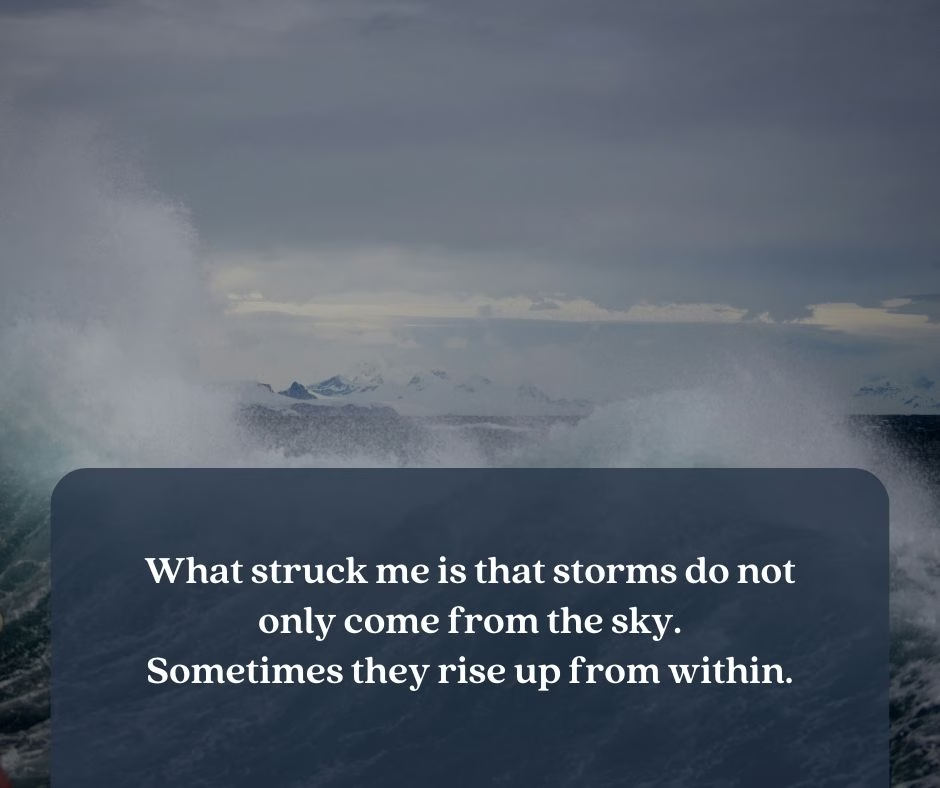
And what struck me is that storms do not only come from the sky.
Sometimes they rise up from within.
And in those moments, the deepest pain is not a problem.
It is proof that we have loved.
It is proof that we are human.
And perhaps, with practice, with support, with willingness to inhabit the middle…
even the deepest pain can soften.
Just a little.
At the edges.
If you’re navigating a difficult season of grief or change, you may also find comfort in this reflection on the slow evolution of the human heart.
Quick Recap: Your Questions Answered
Sometimes you just want the heart of it—here are the key takeaways and common questions people ask.
Emotional spikes—stress, joy, tenderness, or anxiety—can activate stored emotional memory in the nervous system, bringing past grief briefly to the surface.
No. Meditation does not erase grief, but it can help the nervous system metabolize emotional pain so it softens over time.
Grief is stored in emotional and physiological memory, not just in rational understanding, which is why it can appear unexpectedly.
Practices that allow the nervous system to process stress—such as meditation, reflection, and supportive relationships—can gradually help grief integrate.
Yes. Grief often evolves rather than disappears. Many people find it becomes gentler and more spacious with time and emotional processing.
P.S. Don't LET YOUR FRIENDS MISS OUT. Share this article:

Start Your Journey
Receive Expert Guidance on Meditation and Igniting Happiness
"*" indicates required fields
By submitting your information, you consent to subscribe to Meg Reynolds email list. See Privacy Policy.