
Article
What Skiing Taught Me About Letting Go (and Why It Changed Everything)
Category:

By Meg Reynolds,
Published On 04/17/2025
You’re Falling Apart: A Lesson from the Mountain in Letting Go
“You’re falling apart!” Chris yells from behind me, as I teeter on skis at the edge of a sheer drop, trying to navigate a narrow passageway at the top of the mountain.
Stand up. Wider turns. He’s giving clear instructions, but I’m frozen. Turning white as the snow beneath me, my body locks up like a board. Nothing’s computing. People zip past me yelling “On your right!” which only nudges me closer to the cliff on my left. My nervous system is in full fight-or-flight mode.
I am never skiing again.
I can’t get down this.
Where’s the safety team with that sled I saw yesterday?
Am I going to have to die to get out of this?
But my kids are watching, so I can’t fall apart—not completely.
“Chris,” I finally say through gritted teeth, “Stop talking. Just… let me try to do what you already told me, without more instructions right now.”
“Sure,” he says simply.
Let me pause here to say this: Chris is a gem. A proud, self-proclaimed “Masshole” (native of Massachusetts) with an enormous smile, a head full of shaggy white hair, and the grit of someone who’s survived death—literally. Eight minutes clinically dead from a heart attack. A stroke later. And still, he shows up to guide strangers down mountains they’re convinced will be their end.
He’s coughing like he has every respiratory illness in the book, but there he is—full of life, full of service, completely unbothered by my meltdown. He’s going to get me down this mountain, even if it kills him.
Eventually, after a few wild, splattered turns, I funnel out of the narrow chute and onto a much wider slope, where my husband and kids are waiting. The shift from narrow to wide felt like moving through a birth canal—cramped, scary, dark, and then: space. Breath. Light.
They greet me with the awkward, heart-melting compassion of people clunking around in ski boots trying to offer comfort with frozen fingers. My kids don’t try to cheer me up; they just meet me. They don’t talk down to me or tell me I’m fine. They connect. They’re curious. Kind. Aware.
People always tell me how “brave” my kids are for looking adults in the eye and asking how they are. But the truth is—they’re not brave because they’re pushing through fear. They’re mostly fearless. There’s a difference. They know their value. They know their place in the world. Even if they haven’t fully found it yet, they’re confident it’s there.
And my husband, John, ever steady, looks at me and says, “I’m so proud of you.”
Proud? I think. For what? For barely surviving a ski run? For wiping out? For being a total disaster?
But that’s not what he’s proud of. He’s proud that I kept going. That I didn’t bail. That I listened. That I asked for what I needed. That I was willing to let go of control, stop pretending I had it all together, and let the mountain do its thing while I figured out how to work with it—rather than fight against it.
Looking back, it’s clear:
- I was trying to integrate old habits while learning new skills—and that never works.
- I was still leaning forward and backward instead of staying centered.
- Still relying on wedging when I needed fluidity.
- Still looking at the cliff when I should’ve been looking at where I wanted to go.
Chris wasn’t wrong. I was falling apart. But in that unraveling, something important happened.
The Vedic Lesson
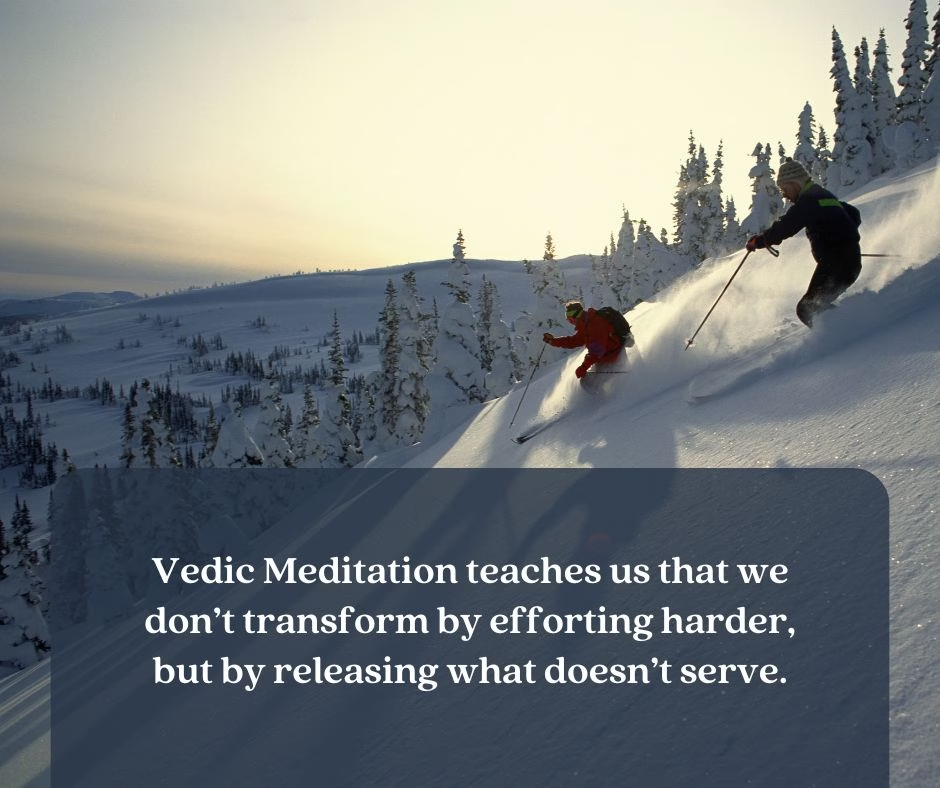
Vedic Meditation teaches us that we don’t transform by efforting harder, but by releasing what doesn’t serve.
Stress leaves the body through release. Growth happens in stillness.
You can’t force new patterns into place while clutching the old ones.
On that mountain, I was reminded that falling apart is sometimes the first step to reintegration—the kind that lasts. The kind that’s embodied. The kind that gets you safely down the mountain, not because you powered through, but because you let go.
In VM, we let go twice a day. We sit. We repeat a simple sound. We allow the mind to transcend. And slowly, gently, over time, the body sheds stress, the mind softens, the nervous system rebalances, and we begin to move through life with a little more space. A little more clarity. A little more trust.
Just like widening out from that narrow chute into the open slope.
Next time life feels like a cliff, don’t panic. Don’t muscle through.
Just breathe. Sit. Listen. Let go.
If you know how to VM, you already know what to do.
Ready to Learn Vedic Meditation?
If you’re ready to stop muscling through life and start experiencing what it means to let go, I’d love to teach you.
Vedic Meditation is simple, effortless, and deeply restorative. It’s taught in person over four days and gives you a lifelong tool for dissolving stress, building resilience, and reconnecting with your calm, capable center—no matter how steep the mountain gets.
If you’re curious about how this actually fits into a real life (including school drop-offs and dinner prep), read Ever Wonder How Meditation Experts Actually Meditate?.
And for a powerful reminder that you don’t need to wait for perfect peace and quiet to begin, this post explores how to create a sacred space anywhere—even if your house is full of noise.
We’d love for you to join us at an upcoming meditation course, meditation retreat, or workplace wellness event.
Let’s get you grounded before the next turn.
P.S. Don't LET YOUR FRIENDS MISS OUT. Share this article:
Start Your Journey
Receive Expert Guidance on Meditation and Igniting Happiness
"*" indicates required fields
By submitting your information, you consent to subscribe to Meg Reynolds email list. See Privacy Policy.