
By Meg Reynolds,
Published On 12/11/2025
When people say “I’ve tried meditation and it’s hard,” they’re usually talking about mindfulness, breath work, or guided practices. These can be valuable—but they often hinge on effort and discipline: you’re told to focus on a word, a sound, your breath, or a body part and ignore everything else.
That means trying not to follow thoughts, noises, itches, to-dos… which is incredibly difficult (if not impossible) for most of us in daily life.
Vedic Meditation (VM) is different. It’s a simple, effortless mental technique that allows the mind to settle without forcing concentration or controlling thoughts.
If you haven’t yet explored the broader tradition behind it, you may appreciate Exploring the Veda, which gives a beautiful foundation for where VM comes from.
Key Differences—Plain and Simple
1) Effort vs. Effortless
Many methods: Ask you to pay attention to one thing and resist distraction. That takes continuous effort.
Vedic Meditation: Uses a personalized sound (mantra) in a relaxed, natural way. No straining, no “doing it right.” The mind eases into rest on its own.
If you’re curious how this “effortlessness” works in daily life, this simple explanation of how to meditate may be helpful.
2) No props, apps, or recordings
Many methods: Depend on guided tracks, timers, or teachers-in-your-ear.
Vedic Meditation: Once you learn, you can practice anywhere, eyes closed, no tech required.
It quickly becomes a reliable, portable reset—whether you’re at home, in the car, or between meetings.
3) Learn once, use forever
I teach VM in four sessions (90 minutes each over four days). After that, you have a lifelong practice.
I’m always here to support you—group meditations, refreshers, and advanced knowledge—but you’ll already have everything you need to keep evolving.
If you’d like to understand what “lifelong support” looks like, see A Lifetime of Support in Vedic Meditation.
4) Fits real schedules
VM is 20 minutes, twice a day. That’s it.
Morning and late afternoon/evening is ideal—easy to integrate without rearranging your life.
A note on “effort and discipline”
Trying to laser-focus on the breath or a body part means pushing away every other sensation or thought. That push is the “effort.”
Doing it again tomorrow, and the next day, is the “discipline.”
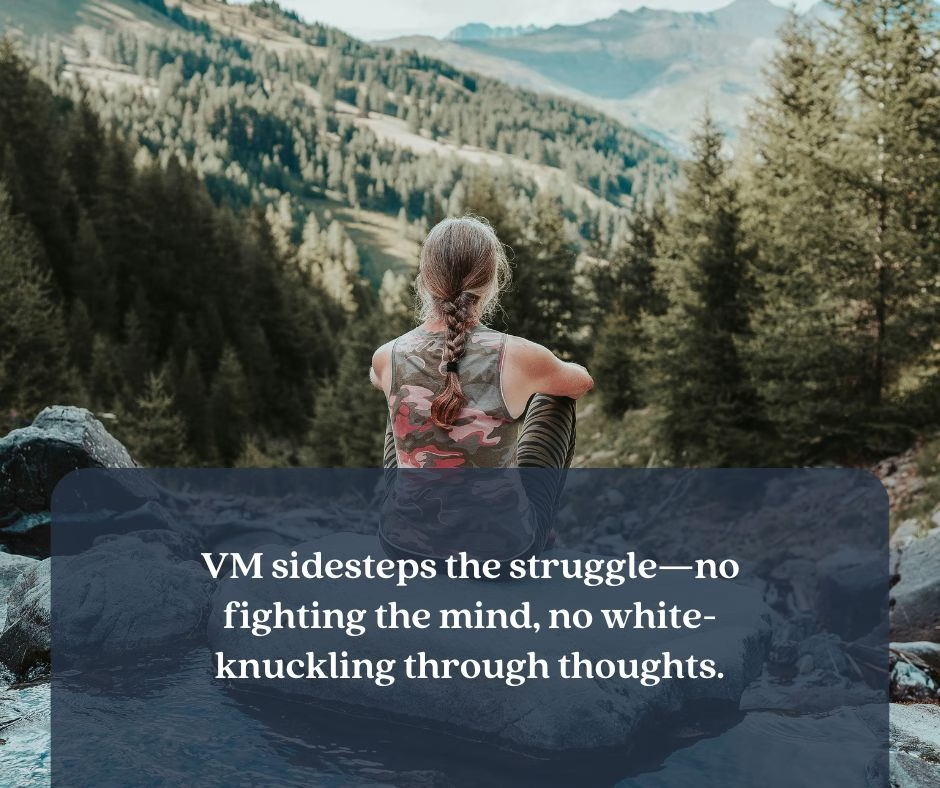
VM sidesteps the struggle—no fighting the mind, no white-knuckling through thoughts.
My take (and why I teach this)
I hold an M.Ed. from the University of Virginia in Social and Emotional Learning—honestly, a glorified mindfulness degree. I’ve met leaders in the mindfulness movement; many have gained tremendous benefit.
But for most of us, devoting our lives to a demanding practice isn’t realistic.
VM offers deep rest and clarity without turning your life upside down.
If you want a meditation you can actually stick with, that feels physically and mentally great as tension releases—Vedic Meditation was designed for exactly that.
Curious? Learn it once over four 90-minute sessions, and it’s yours for life.
Quick Recap: Your Questions Answered
Sometimes you just want the heart of it—here are the key takeaways and common questions people ask.
Because it doesn’t require concentration, breath control, or trying to stop thoughts. It works with the mind’s natural tendencies rather than against them.
No. Mindfulness is about directing attention. Vedic Meditation is about letting the mind settle effortlessly using a personalized sound.
No. Once you learn it, VM is completely self-sufficient—you can practice anywhere, anytime.
Four 90-minute sessions, taught over four consecutive days. After that, you have a lifelong, fully independent practice.
Anyone with a busy mind, demanding schedule, or high stress load. Many people with ADD/ADHD find it especially supportive.
P.S. Don't LET YOUR FRIENDS MISS OUT. Share this article:

Start Your Journey
Receive Expert Guidance on Meditation and Igniting Happiness
"*" indicates required fields
By submitting your information, you consent to subscribe to Meg Reynolds email list. See Privacy Policy.